Doing in-house development doesn’t necessarily mean that you’ll save money. Do you know why?
28 July 2022

When speaking with potential customers about the benefits of working in a nearshore approach, I am often asked:
- Why should we search for nearshore development when we already have our core software established?
- Why do nearshore, when we have an in-house development team? What is the difference?
- What are the real advantages that nearshore can bring to my company?
Those are excellent questions that I have been shaping into a clear picture, throughout my career. I had the opportunity to see different models, from fixed size projects, or outsourcing or even pure recruitment. And I came to understand the real value of nearshore and tailored software, and how this has improved, and grown businesses in a battle tested way.
Nearshore typically means collaborating with an outsourcing partner based in a neighbouring Country, with similar time zone. This is becoming more common among companies who aspire to obtain high-quality results and appreciate the added flexibility it brings.
However, we should start by explaining why do companies nearshore?
Entrepreneurs and companies of all sizes can benefit from having a nearshore team. Nearshoring gives access to highly skilled talent, with proven experience, easy management, low risk, and able to scale according to your needs. Furthermore, having a software custom developed for you is game-changing for your business. From the first contact with the business team to the last line of code, tailored software guarantees good work practice guidelines that bring great MVP, proven results, cloud-native experiences, as well as frequent audits and assessments of security breaches in code.
Why do nearshore when we have an in-house development team? If your answer is budget, doing in-house development doesn’t necessarily mean that you’ll save money. It may be appealing at first, but it can turn out to be expensive over time. Here are a few reasons why:
A big and fast-growing project will require a wide number of specialised developers, which is expensive and time-consuming to hire people in the IT sector, especially when you need several skills in development. At first, you’ll need to hire senior profiles to bring experience to the project and to help you then hire mid or junior developers. Establishing a senior team, with different competencies or technical skills could be the first big challenge. The second biggest challenge, also related to HR, is retention. It is common knowledge that turn-over in this area is notoriously high. You are investing significant time and resources in building a team, but then sadly staff members end up leaving your team, leaving you to pick up the pieces. As a result, your project may come to a halt or slow down for a considerable amount of time.

There are other challenges that we need to reflect on. When we have an in-house team dedicated to projects, we need to invest in numerous IT resources and tools, such as licenses, hardware, and equipment. We do long-term contracts and sometimes we need multiple skills/profiles less than 100% of the time. By choosing a nearshore software house, you reduce costs related to employee recruitment, insurance fees, additional training, salary payments, office expenses, vacations, and reduce hiring and retention effort. You can also have the opportunity to have a more diversified team, hired by the hour, at a fixed rate, which often includes equipment and licenses.
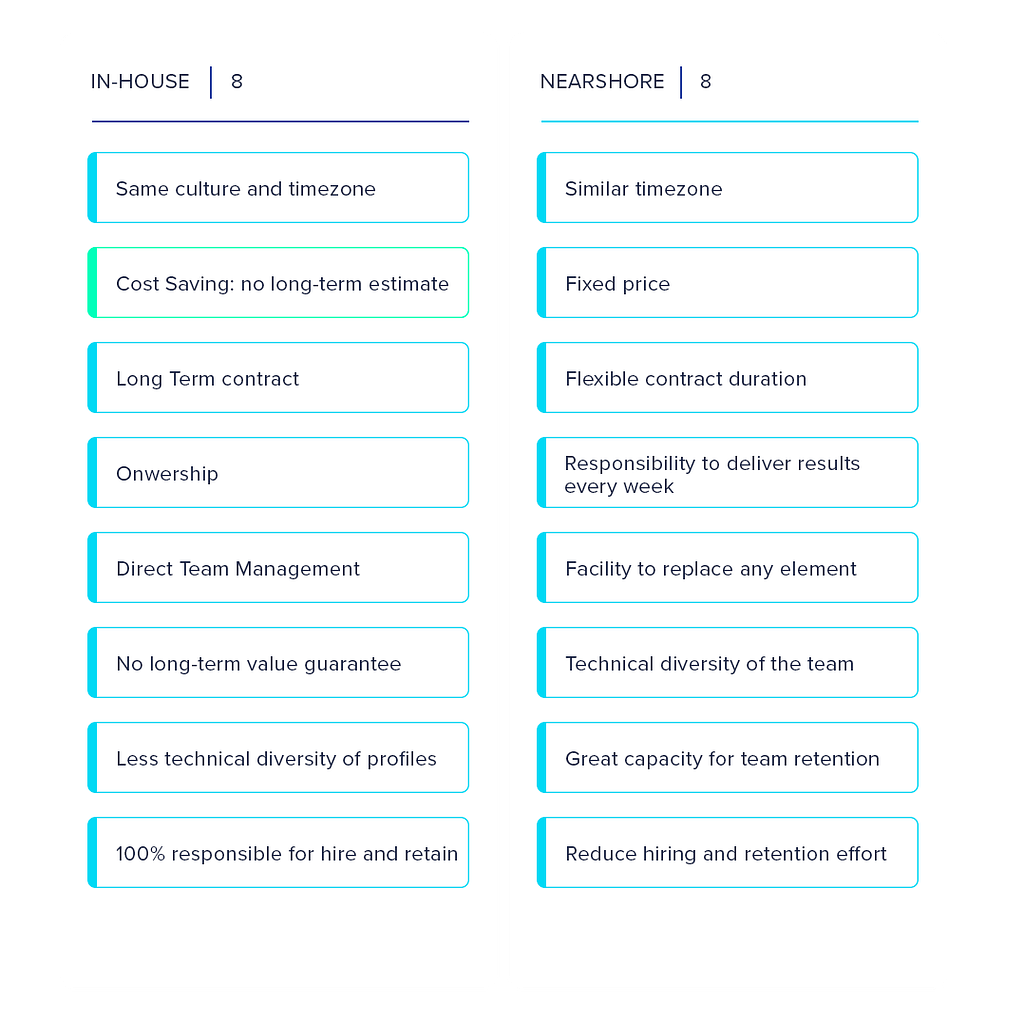
In addition, nearshore software development teams are already well-established and have completed multiple projects together, with proven results. Even though they are an external team, they do not have to work separately. In fact, from our perspective, the best way to obtain positive results is when we mix the nearshore team with some internal team and allow direct contact between them. Here is a snippet on how we do it:
1. Make your nearshore team as much of a direct extension as possible.
2. Have the same control over the project, ask for results, and be involved in the entire development process.
3. Develop constant communication and feedback.
This will also help in the integration of the project and perception of the organisational culture.
So, why should you invest in Nearshore?
A key fact to consider when choosing a development model is that, if web or software development isn’t your company’s core competencies, it may be overwhelming to hire and retain an IT staff from scratch, and you might end up hiring a Nearshore team anyway after unsuccessful attempts.
By Investing in a Nearshore partner you can probably reduce the unsuccessful attempts, choosing the best solution, languages, and tools, at the beginning. You can share risks, responsibilities, replace any element of your team if required, all adapted and tailormade to your project needs, and with fixed rates.

At craftable, we give 100% from ourselves to the project. We’re project driven and we love to try new things and take on complex challenges. As a nearshore partner we have the responsibility to deliver results every week. Learn more about how we do it on our website
Also, investing in Portugal means that you’ll have access to highly skilled experts, from world ranked Portuguese Universities, who are hard-working, and proficient in English.
Doing in-house development doesn’t necessarily mean that you’ll save money. Do you know why? was originally published in craftable on Medium, where people are continuing the conversation by highlighting and responding to this story.